
Many facilities believe their safety culture is solid until an incident reveals the cracks. Each year, organizations invest in workplace safety training that looks credible on paper but fails where it matters most: in the daily, high-pressure decisions of the workforce. The most significant operational failures aren’t usually caused by a lack of corporate intent; they are caused by relying on static training that was never engineered to drive real behavioral change or long-term retention.
Choosing a training platform is about more than checking an OSHA compliance box—it is about securing the productivity, reliability, and morale of your entire operation.
The Hidden Drag of Low-Quality Training
At first glance, many safety training courses seem interchangeable. They use the same regulatory buzzwords and promise the same basic instruction. However, there are significant adult-learning principles that should be baked into training, creating the difference between a high-retention program and check-the-box exercise.
When a program isn’t aligned with the practical reality of your floor, its value evaporates, leaving a trail of “hidden drag” on your operations:
- Relevance Is Key: Training courses are always better if workers recognize the situations and environmental surroundings in the courses. Food manufacturers should leverage libraries that are set in food manufacturing environments, with real-life scenarios and simulations that workers will relate to. Additionally, a modern platform makes it easy for administrators to build role-specific learning plans so workers are conditioned to “tune out” by sitting through courses not relevant to their job requirements.
- Safety Fatigue: Employees quickly disengage from uninspired, repetitive content. This leads to a dangerous “shortcut culture” where safety protocols are viewed as bureaucratic obstacles rather than life-saving protections. Over time, this fatigue erodes the very vigilance needed to prevent risky behaviors and consequent injuries.
- Knowledge Decay: Without adult learning and retention-based design principles—such as micro-learning bursts, scenario-based storytelling, virtual simulations, and interactive exercises—the lessons learned are often forgotten within weeks. This leaves your team vulnerable to preventable injuries because they lack the internalized awareness to identify hazards in real-time, even if they technically “passed” a test.
Choosing the wrong content library—or relying on training built internally from stretched-thin resources who aren’t adult learning or subject matter experts—- doesn’t just risk a fine; it risks the institutional confidence that keeps a facility running at peak efficiency.
The Trap of “Paper Safety”
The most dangerous operational failures are often the ones you cannot see on a spreadsheet. This is what industry leaders call “paper safety”—a state where documentation looks perfect, but the workforce lacks actual, functional awareness. If a supervisor cannot explain a hazard control or an employee can’t recall an emergency procedure during a moment of high stress, the training system has fundamentally failed.
This illusion of safety is what leads to chronic, repeat incidents in critical categories like hazard communication, fall protection, and lockout/tagout (LOTO). Companies that rely on low-engagement training often discover their error only after a recordable injury triggers a spike in turnover or a dip in production. What looked like a budget win during the procurement phase quickly becomes an operational liability that destroys morale and forces management into a reactive “firefighting” mode.
SkillUp: Building a Verifiable Safety Foundation
At Registrar Corp, we advocate for a digital approach to safety management. Our SkillUp training platform provides a robust library of highly interactive eLearning courses, built specifically for the food manufacturing industry, that are designed to serve as the bedrock of your safety culture.
SkillUp provides multi-lingual training that includes scenario-based simulations in a virtual facility and interactive exercises to reinforce instruction by doing. . By establishing a unified language of safety across your entire workforce, you ensure that every worker has the confidence and clarity needed to navigate a modern, complex production environment. A strong foundational system ensures that:
- Retention is a Metric, Not an Afterthought: Our content is built for active engagement, ensuring that safety principles stay top-of-mind during daily tasks rather than being filed away and forgotten.
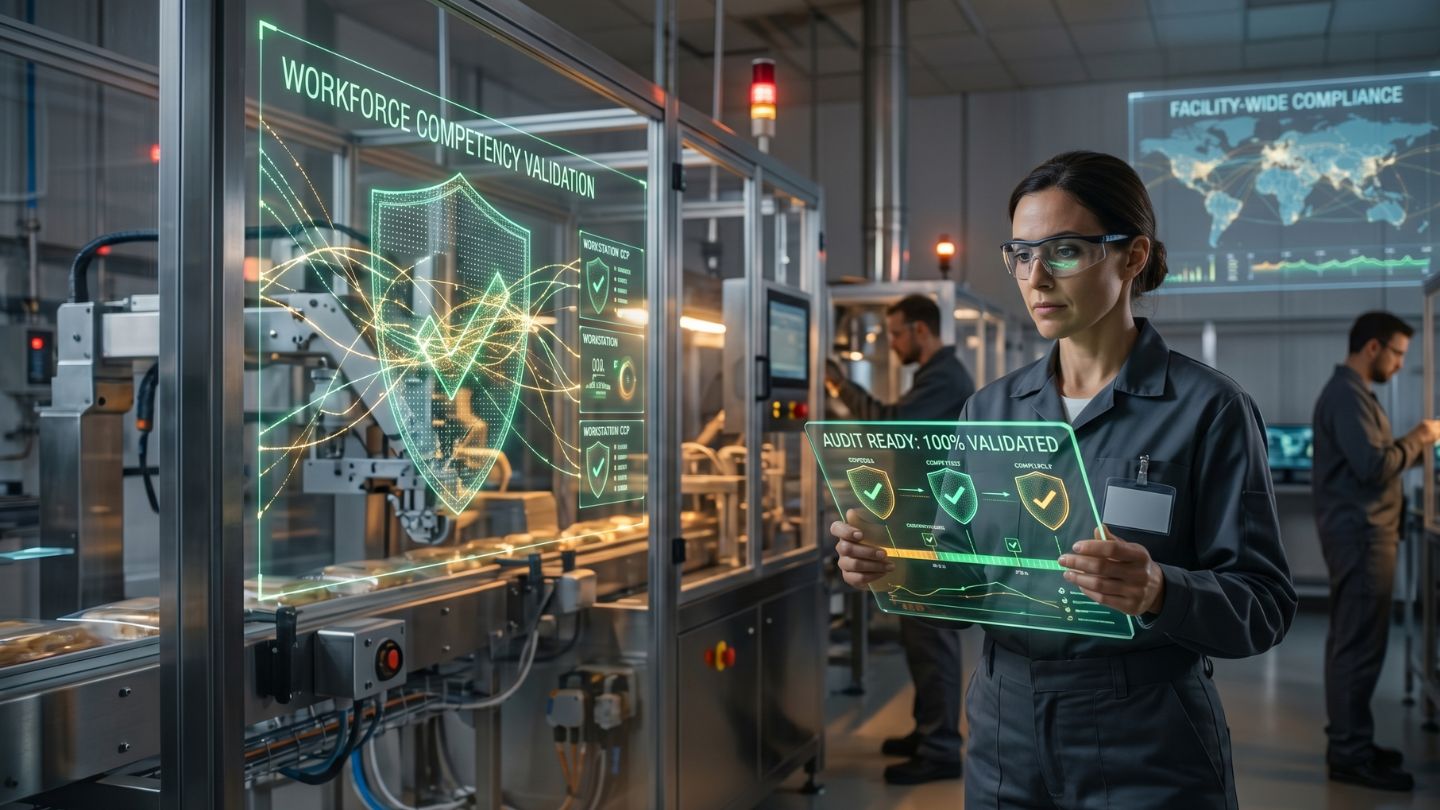
- Training Records are Traceable and Transparent: Every completion is timestamped, authenticated, and verifiable within a specialized LMS, providing the “performance insurance” your facility needs for future audits and insurance reviews. Beyond attendance, the training records include proof when workers answer quiz questions correctly.
- Standards Evolve with Your Industry: Content maps to the latest regulatory requirements and industry best practices, so your team is never operating with outdated or irrelevant information.
Bridging the Gap with Site-Specific Precision
Even the most effective foundational training must eventually adapt to the specific physical realities of your facility. A primary friction point for many operations leaders is that universal safety training often fails to account for proprietary machinery, unique chemical inventories, or complex floor layouts.
We solve this through our AI Create course creation software. This tool allows you to take the expert-backed, comprehensive safety training from our library and layer in the precise, site-specific details your team needs to be successful in their actual work environment.
The Foundation: Critical Safety Training Leverage SkillUp for key foundational modules that set the standard for your workforce. This core library provides comprehensive coverage of vital topics such as PPE standards, bloodborne pathogen safety, and critical fire safety protocols.
The Application: Operational Precision Use AI Create to build highly localized guides, such as facility-unique LOTO protocols for specialized machinery, proprietary chemical handling instructions, or emergency evacuation paths tailored specifically to your building’s footprint.
The Result: A Dual-Layered Safety Program By resolving the “generic training” hurdle, you ensure that your safety program acts as both a comprehensive shield for your workforce and a precise, surgical tool for your specific operational challenges.
Operational Insurance for a Productive Future
A workplace safety program should be viewed as operational insurance for your most valuable assets. By centralizing your foundational awareness and your site-specific training needs through a comprehensive LMS, you move from a state of reactive compliance to a state of predictable stability.
Registrar Corp has been a global leader in compliance and workforce development for over 20 years, trusted by 35,000 clients worldwide. Our workplace safety training provides the verifiable proof, confident employees, and measurable improvement necessary to protect your people, your reputation, and your long-term profitability.
Secure your facility’s operational health today:
- Explore Foundational Awareness in the SkillUp Library
- Create Your Own Site-Specific Modules with AI Create
- Centralize Your Safety Management with our LMS